





































The Invisible Engine: Why Human Capital is the True Rocket Fuel for the Modern Economy
The Invisible Engine: Why Human Capital is the True Rocket Fuel for the Modern Economy
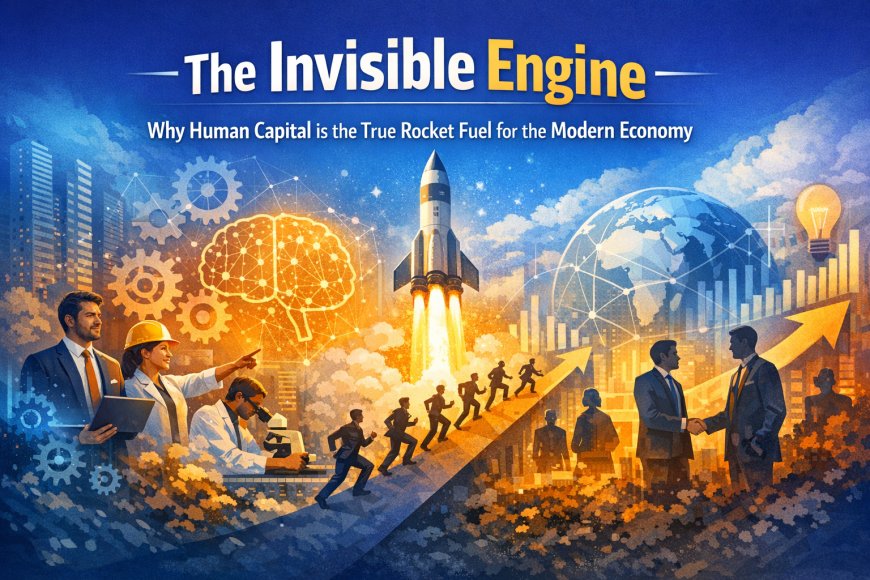
In the complex machinery of global finance, economists and policymakers often focus on the gears they can see: interest rates, trade balances, and industrial output. While these metrics are vital indicators of a nation’s health, they are merely the gauges on the dashboard. They are not the propellant.
As we navigate an era defined by rapid digitization and shifting geopolitical alliances, a consensus is emerging among leading economic strategists. The "rocket fuel" for a growing economy is not found in a central bank’s vault or a subterranean oil reserve. Rather, it is found in the **Knowledge-Innovation Nexus—the strategic synergy between human capital and technological integration.**
Here is why this invisible engine is the most potent driver of sustainable economic expansion in the 21st century.
The Shift from Tangible to Intangible Assets
For much of the 20th century, economic dominance was a game of physical scale. The nations with the most factories, the largest labor forces, and the most abundant raw materials won. However, in the modern landscape, the value of "intangible assets"—intellectual property, software, and specialized expertise—has overtaken physical capital.
Expert analysis suggests that for every dollar invested in digital transformation and specialized education, the return on GDP is significantly higher than traditional infrastructure spending. This is because knowledge-based growth is non-rivalrous; unlike a physical tool, an idea or a piece of software can be used by millions simultaneously, creating an exponential rather than a linear growth curve.
Human Capital: The High-Octane Component
When we speak of "Human Capital," we are not just talking about a workforce. We are talking about a population’s collective ability to solve complex problems.
A growing economy requires a workforce that is not merely "employed" but is "adaptable." In a professional landscape where AI and automation are redefining roles monthly, the ability of a nation to upskill its citizens becomes its greatest competitive advantage. This is the "rocket fuel" in its purest form: a labor force that can leverage emerging technologies to increase productivity rather than being displaced by them.
Economic experts point to "Total Factor Productivity" (TFP) as the ultimate metric of success. TFP measures how efficiently an economy uses its inputs. When a workforce is highly educated and technologically fluent, TFP skyrockets. You are essentially getting more output from the same amount of labor and capital.
The Ecosystem as the Oxidizer
Fuel alone cannot create combustion; it requires an oxidizer. In economic terms, this is the institutional environment. Even the most talented workforce will stagnate if trapped in a system defined by bureaucracy, lack of IP protection, or restricted access to capital.
To ignite the rocket fuel of human capital, an economy requires:
1. **A Culture of R&D:** Incentivizing private and public research ensures that the "fuel" is constantly being refined.
2. **Regulatory Agility:** Laws must evolve as fast as the technology they govern to prevent "innovation flight."
3. **Digital Infrastructure:** High-speed connectivity is the "pipeline" that delivers the fuel to the engine of commerce.
The Multiplier Effect
The reason experts highlight this specific combination as "rocket fuel" is its unique multiplier effect. When a government or corporation invests in the intersection of talent and technology, it creates a virtuous cycle. High-skill jobs attract global investment; investment funds further education and infrastructure; and a robust infrastructure attracts more talent.
This cycle creates a "moat" around an economy, making it resilient to the boom-and-bust cycles of commodity-based markets. While oil prices may fluctuate and manufacturing may move to lower-cost regions, a hub of innovation and human expertise remains a permanent magnet for wealth.
The Path Forward
As we look toward the mid-2020s, the message for leaders is clear: The race for economic supremacy is no longer a race for resources, but a race for relevance.
To power a growing economy, we must move beyond the rhetoric of "job creation" and focus on "value creation." By investing in the cognitive abilities of the population and providing them with the technological tools to scale their ideas, we provide the high-octane fuel necessary to propel an economy into the next frontier.
The nations that recognize this today will be the superpowers of tomorrow. The fuel is ready; the question is whether we have the courage to ignite it.
What's Your Reaction?
 Like
0
Like
0
 Dislike
0
Dislike
0
 Love
0
Love
0
 Funny
0
Funny
0
 Angry
0
Angry
0
 Sad
0
Sad
0
 Wow
0
Wow
0