














































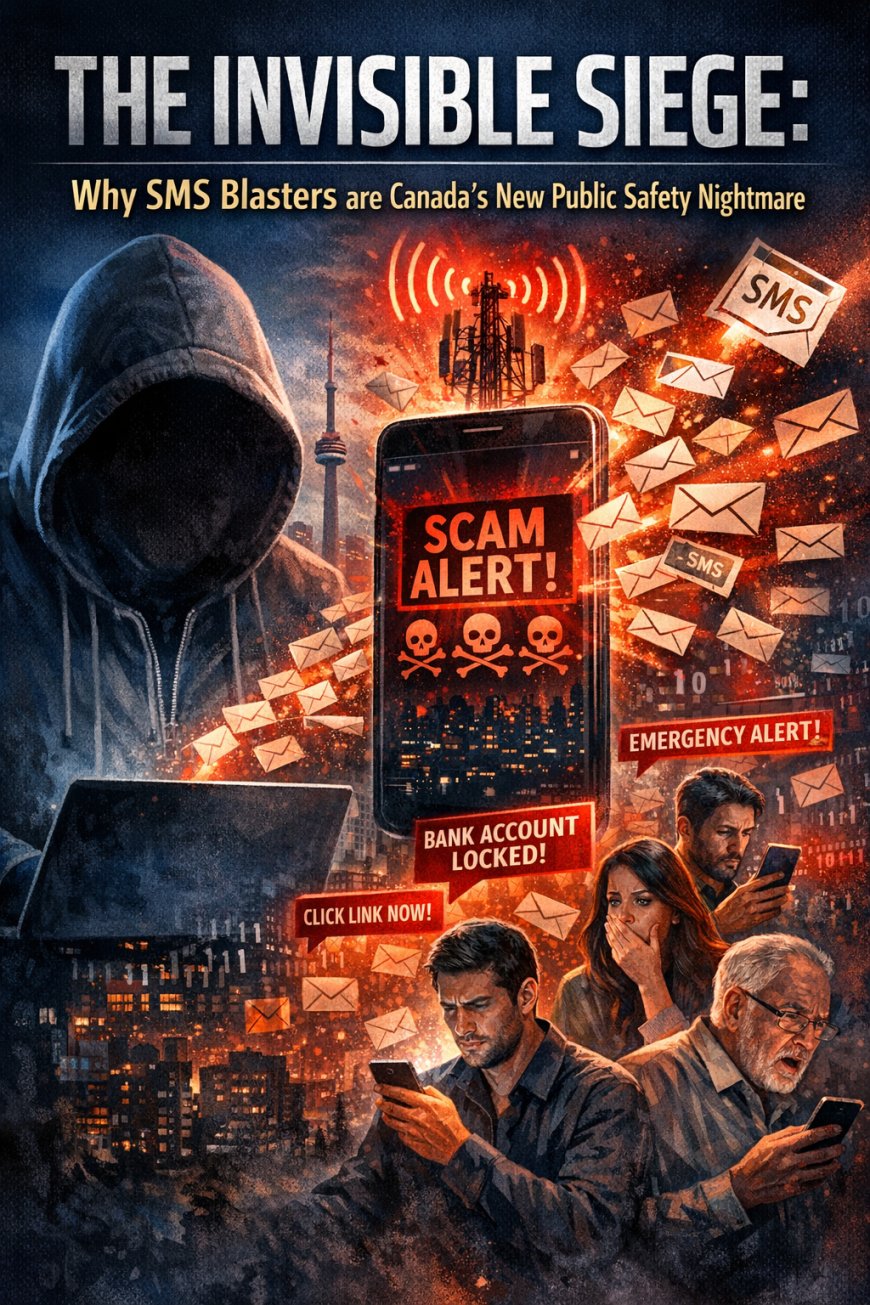
The Invisible Siege: Why SMS Blasters are Canada’s New Public Safety Nightmare
The Invisible Siege: Why SMS Blasters are Canada’s New Public Safety Nightmare
For years, we’ve been told that cybercrime is a "white-collar" problem. We’ve been conditioned to think of it in terms of stolen credit card numbers, drained bank accounts, and the annoying inconvenience of resetting passwords. We view it as a financial risk—a tax on our digital existence.
But recently, the streets of Canada became the front line of a much more physical, much more dangerous kind of warfare.
Reports have surfaced of hackers "war-driving" through Canadian neighborhoods equipped with **SMS blasters**—portable, illegal radio devices that mimic cell towers. These weren’t lone wolves operating from a basement halfway across the world; these were criminals physically patrolling our streets, casting a digital net over every person they passed.
The numbers are staggering: **13 million network disruptions and thousands of compromised devices.**
If we continue to view this through the narrow lens of financial fraud, we are missing the most terrifying part of the story. This isn't just about money anymore. This is a direct assault on public safety.
The Anatomy of a Digital Ambush
An SMS blaster (or IMSI catcher) works by tricking your phone into thinking it’s connecting to a legitimate cell tower. Once your phone "handshakes" with the device, the attacker can bypass firewalls, intercept data, and flood your phone with sophisticated phishing links.
But here is the catch: to do this, the blaster must forcibly disconnect you from your actual service provider.
When 13 million disruptions occur, we aren't just talking about dropped calls or slow Netflix speeds. We are talking about the systematic dismantling of our emergency infrastructure.
When "No Service" Becomes a Death Sentence
Imagine you are walking home and witness an accident. Or worse, imagine a medical emergency in a household where the "war-driving" car is currently passing by. You reach for your phone to dial 911, only to find your device trapped in the "dead zone" created by an SMS blaster.
This isn't a hypothetical fear. Our entire public safety architecture—from Amber Alerts and wildfire evacuations to the ability to reach emergency dispatchers—relies on the integrity of our cellular networks. When hackers crawl our streets and disrupt these signals on a massive scale, they aren't just "hacking phones." They are cutting the digital lifelines that keep our communities safe.
By disrupting 13 million connections, these attackers created 13 million opportunities for a tragedy to go unreported.
The Proximity of the Threat
The most chilling aspect of the Canadian SMS blaster attacks is their physical nature. Traditional phishing happens in the ether. But this? This is local. It’s a car parked outside your local grocery store. It’s a van driving past your child’s school.
This proximity turns our most personal device—the one that never leaves our side—into a tracking beacon and a vulnerability. By compromising thousands of devices, hackers gained more than just banking credentials; they gained access to locations, private messages, and the ability to monitor the movements of Canadian citizens in real-time.
A Call for Radical Action
For too long, the response to SMS-based crime has been: *"Don't click the link."*
That is no longer enough. You cannot "personal responsibility" your way out of a network-level disruption. When criminals can drive through a major metropolitan area and knock millions of people off their secure networks, the "financial risk" is the least of our worries.
We need to stop treating these incidents as mere "scams" and start treating them as **attacks on critical infrastructure.**
1. **Stricter Enforcement:** The hardware used for SMS blasting should be treated with the same legal severity as signal jammers or illegal firearms.
2. **Telco Accountability:** Canadian telecommunications giants must move faster to implement protocols that detect and "kill" rogue base stations the moment they appear on the grid.
3. **Public Awareness:** We need to shift the narrative. The public needs to understand that a "SOS" or "No Service" icon in a high-coverage area isn't always a glitch—it could be a crime in progress.
The Bottom Line
The 13 million disruptions in Canada serve as a wake-up call. We are entering an era where the boundary between the digital and the physical has completely dissolved.
If a group of people stood on a street corner and physically blocked 13 million people from accessing a hospital, we would call it a national crisis. Why are we reacting any differently when they do it with radio waves?
It’s time to look beyond our wallets and realize that our very safety is on the line. The hackers are no longer just in our computers; they are on our streets. It’s time we drove them off.
What's Your Reaction?
 Like
0
Like
0
 Dislike
0
Dislike
0
 Love
0
Love
0
 Funny
0
Funny
0
 Angry
0
Angry
0
 Sad
0
Sad
0
 Wow
0
Wow
0