

















































The Democratization of Lethality: Assessing Nigeria’s Strategic Readiness for AI-Integrated Drone Warfare
The Democratization of Lethality: Assessing Nigeria’s Strategic Readiness for AI-Integrated Drone Warfare
Introduction
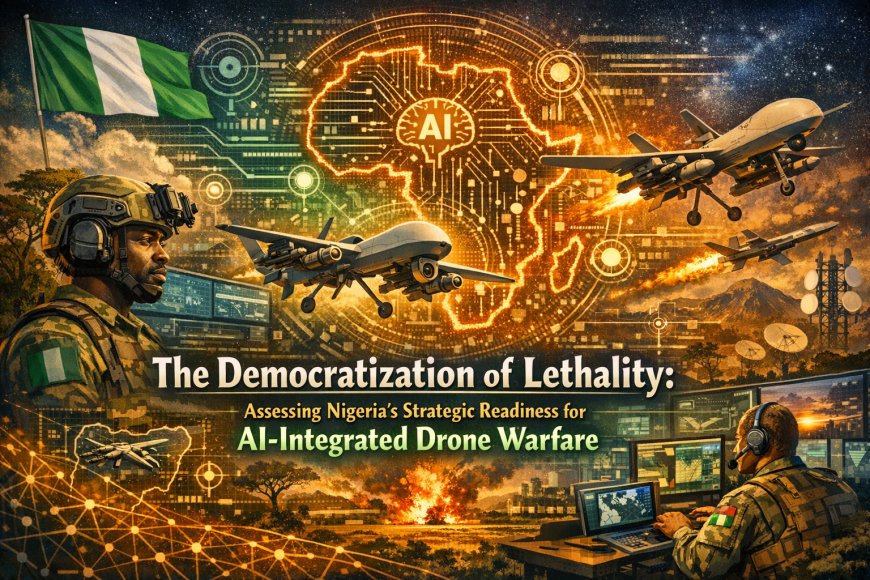
The character of conflict is undergoing a seismic shift. The era of aerial dominance, once the exclusive preserve of technologically advanced nation-states wielding multi-million dollar platforms like the MQ-9 Reaper, has been supplanted by what defense analysts term the "Second Drone Age." Today, the battlefield is defined by the democratization of lethality—where low-cost, commercial off-the-shelf (COTS) drones are modified into precision-guided munitions.
As Artificial Intelligence (AI) migrates from centralized cloud servers to "edge" processors on small aircraft, the specter of autonomous "smarter killers" looms. For Nigeria, a nation currently grappling with multi-front internal security challenges, this technological leapfrogging presents a dual-use paradox: a potent tool for counter-insurgency and a catastrophic threat in the hands of non-state actors. This article examines the intersection of cheap drone technology and AI, questioning whether Nigeria’s strategic infrastructure and doctrine are prepared for this inevitable evolution in warfare.
The Rise of the Low-Cost Attrition Model
The conflict in Ukraine and the Nagorno-Karabakh war have served as laboratories for modern attrition. The primary takeaway is the efficacy of the "cheap and many" over the "expensive and few." FPV (First-Person View) drones costing less than $500 have successfully neutralized main battle tanks worth millions.
In the Nigerian context, the proliferation of these systems is already a reality. While the Nigerian Air Force (NAF) has invested in high-end Chinese-made Wing Loong II and CH-4 UCAVs (Unmanned Combat Aerial Vehicles), insurgent groups such as ISWAP and Boko Haram have begun utilizing basic drones for Intelligence, Surveillance, and Reconnaissance (ISR). The transition from surveillance to weaponization—using AI for target acquisition—is a short technical step that bypasses traditional military procurement cycles.
The AI Inflection Point: From Remote Control to Autonomy
The true danger lies in the integration of AI. Traditional drone countermeasures, such as electronic jamming of radio frequencies or GPS spoofing, rely on severing the link between the pilot and the craft. However, AI-driven drones are increasingly capable of "terminal autonomy."
Equipped with computer vision algorithms, these drones can identify, track, and strike targets without a human-in-the-loop. This renders traditional electronic warfare (EW) suites obsolete. If an insurgent group can deploy a swarm of ten drones programmed to recognize and dive-bomb military checkpoints or soft targets, the defensive requirements change from signal jamming to kinetic interception—a much more difficult and expensive task.
Nigeria’s Security Landscape and Vulnerabilities
Nigeria’s internal security architecture is currently stretched across the North-East (insurgency), the North-West (banditry), and the South-East (secessionist agitations). The introduction of AI-enhanced drones into these theaters would exacerbate existing vulnerabilities in several ways:
1. **Asymmetric Parity:** AI levels the playing field. A small group of bandits could theoretically achieve the precision-strike capability of a conventional air force without the need for runways, pilots, or complex logistics.
2. **Urban Warfare Complexity:** In densely populated areas like Lagos or Kaduna, the use of small, autonomous drones for targeted assassinations or IED delivery creates a nightmare scenario for law enforcement, where attribution becomes nearly impossible.
3. **Critical Infrastructure:** Nigeria’s oil pipelines, power grids, and telecommunications masts are sprawling and difficult to guard. AI drones capable of autonomous navigation could strike these assets with surgical precision, evading standard patrols.
The Readiness Gap: Policy and Technology
Is Nigeria ready? An assessment of current capabilities suggests a significant lag between the pace of technological adoption and institutional response.
Regulatory Frameworks: While the Nigerian Civil Aviation Authority (NCAA) and the Office of the National Security Adviser (ONSA) have established guidelines for drone operations, these are largely focused on civilian compliance. There is a lack of a robust, unified doctrine on "Counter-UAS" (Unmanned Aircraft Systems) that specifically addresses AI-integrated threats.
Technological Countermeasures: Nigeria’s current defense spending remains heavily weighted toward kinetic platforms (aircraft, APCs). There is insufficient investment in directed-energy weapons, microwave emitters, or AI-driven "interceptor drones" designed to neutralize enemy swarms.
Research and Development: The Air Force Institute of Technology (AFIT) and the Defence Industries Corporation of Nigeria (DICON) have made strides in indigenous drone production (e.g., the Tsaigumi UAV). However, the software component—the AI algorithms required for autonomous threat detection—remains largely imported or underdeveloped.
Ethical and Strategic Imperatives
Beyond the tactical, Nigeria must navigate the ethical minefield of AI warfare. The use of autonomous systems raises profound questions regarding "meaningful human control" and the risk of collateral damage. If a Nigerian-operated AI drone misidentifies a civilian gathering as a bandit camp, the legal and moral accountability remains murky.
Furthermore, there is the risk of an "AI arms race" within the West African sub-region. As Nigeria adopts these technologies, neighboring states and non-state actors will inevitably seek countermeasures, leading to a cycle of escalation that could destabilize regional security.
Conclusion: A Call for Strategic Proactivity
Nigeria stands at a crossroads. The "smarter killer" is no longer a trope of science fiction; it is a budget-friendly reality available on the global gray market. To be ready, Nigeria must move beyond the mere acquisition of hardware.
A proactive strategy requires three pillars:
1. **Investment in EW and C-UAS:** Prioritizing the acquisition and indigenous development of electronic warfare systems capable of detecting and neutralizing autonomous threats.
2. **Software-Centric Defense:** Shifting focus from the "airframe" to the "algorithm" by fostering a domestic ecosystem of AI developers and data scientists within the defense sector.
3. **Legislative Agility:** Developing a legal framework that addresses the use of AI in domestic security, ensuring that the state remains ahead of the curve in both utilization and regulation.
The sky is no longer just a theater of operations; it is a data-driven battlefield. If Nigeria fails to prepare for the era of cheap, smart drones, it risks being outpaced by the very actors it seeks to suppress. The cost of entry into AI warfare is low, but the cost of being unprepared is immeasurably high.
What's Your Reaction?
 Like
0
Like
0
 Dislike
0
Dislike
0
 Love
0
Love
0
 Funny
0
Funny
0
 Angry
0
Angry
0
 Sad
0
Sad
0
 Wow
0
Wow
0