
















































The Missing Architecture: Why Enterprise AI Requires an Evidence and Control Layer
The Missing Architecture: Why Enterprise AI Requires an Evidence and Control Layer
- For the past eighteen months, the corporate world has been caught in a whirlwind of "POC Purgatory." Thousands of enterprises have built impressive internal pilots using Large Language Models (LLMs), yet only a fraction have successfully transitioned these applications into mission-critical production environments.
The bottleneck isn't the intelligence of the models—it’s the lack of infrastructure surrounding them. As organizations move from "playing with AI" to "running on AI," a new architectural requirement has emerged: **The Evidence and Control Layer.**
The Trust Gap in Probabilistic Systems
Traditional software is deterministic; if you write a line of code to calculate a tax rate, it performs that calculation the same way every time. Generative AI, however, is probabilistic. It predicts the next most likely token based on patterns, not logic.
This inherent unpredictability creates a "Trust Gap." For a consumer-facing chatbot recommending a movie, a minor hallucination is a nuisance. For an enterprise AI managing supply chain logistics, medical diagnostics, or financial compliance, a hallucination is a liability.
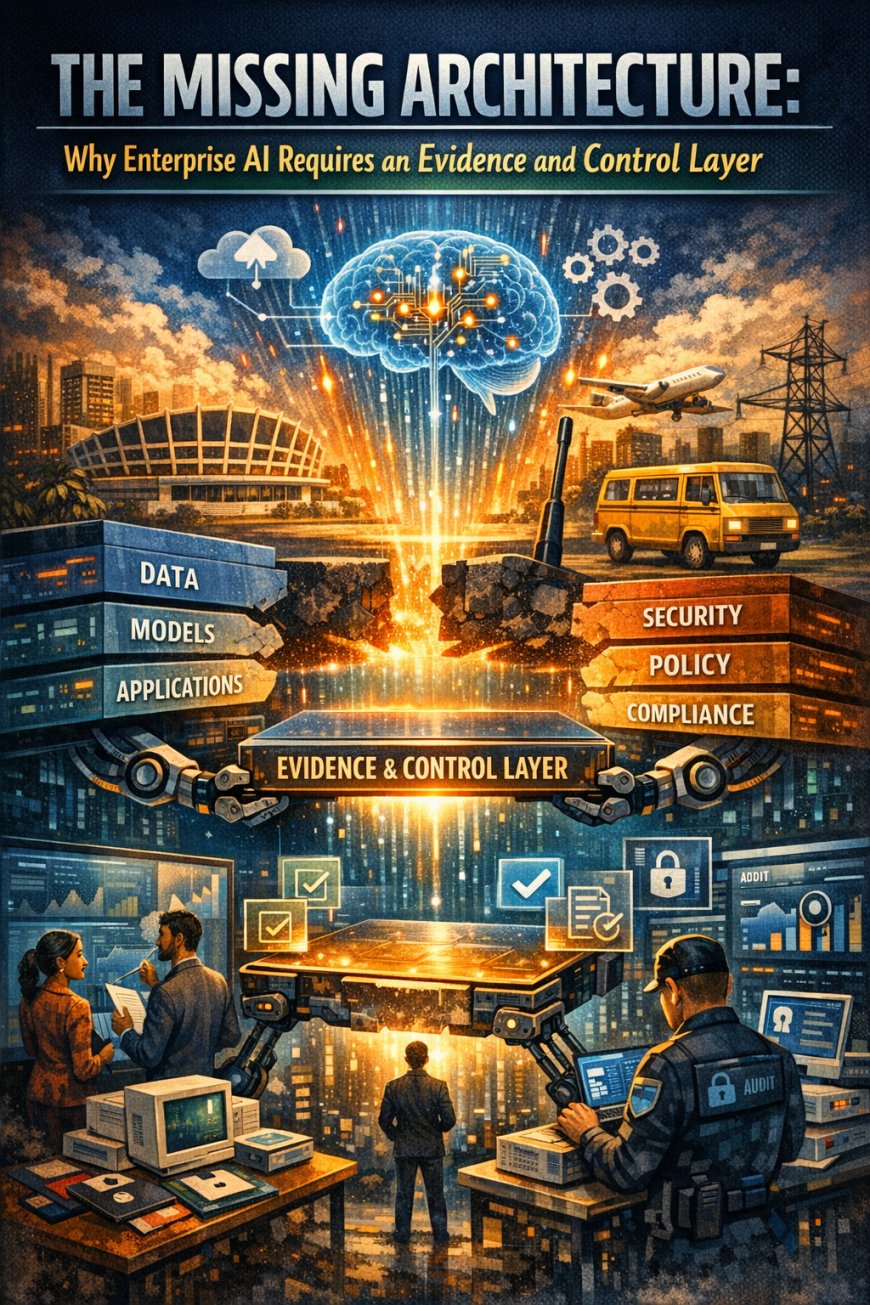
To bridge this gap, enterprises cannot rely solely on the "Model Layer" (the LLM) or the "Application Layer" (the UI). They need a middleware layer designed specifically for verification and safety.
---
The Evidence Layer: Moving Beyond "Black Box" Outputs
The Evidence Layer is responsible for the **provenance and grounding** of AI outputs. In an enterprise context, an answer is only as good as the data supporting it.
1. Verifiable Grounding
Most enterprises use Retrieval-Augmented Generation (RAG) to connect LLMs to their internal data. However, simply providing a list of sources isn't enough. The Evidence Layer must perform "claim-level verification"—breaking down an AI’s response into individual assertions and mapping each one to a specific, verifiable data point in the underlying documentation.
2. Auditability and Traceability
In regulated industries, "because the AI said so" is not an acceptable defense. The Evidence Layer maintains a comprehensive audit trail. This includes the exact version of the model used, the specific prompts provided, the data retrieved at that timestamp, and the reasoning path the model took. This transforms the "black box" into a transparent ledger.
---
The Control Layer: The Brakes That Allow You to Go Fast
If the Evidence Layer is about truth, the Control Layer is about **safety and policy.** If you want to drive a car at 100 mph, you don't just need a powerful engine; you need world-class brakes.
1. Real-Time Guardrails
The Control Layer acts as a bidirectional filter. On the input side, it detects and blocks prompt injections or attempts to bypass company policy. On the output side, it scans for PII (Personally Identifiable Information) leaks, toxic language, or brand-inconsistent messaging before the user ever sees it.
2. Operational Governance
Enterprise AI requires granular controls over who can access which models and what data. The Control Layer integrates with existing Identity and Access Management (IAM) systems to ensure that an AI agent doesn't inadvertently disclose executive compensation data to a junior employee, even if that data is technically within the model’s reach.
3. Cost and Performance Management
Unchecked AI usage can lead to "token sprawl" and spiraling API costs. The Control Layer provides a centralized point for rate limiting, model routing (sending simple tasks to cheaper models and complex tasks to premium ones), and performance monitoring.
---
The Regulatory Imperative
The shift toward a dedicated Evidence and Control Layer isn't just a technical best practice—it is becoming a legal necessity. With the advent of the **EU AI Act** and evolving SEC guidelines regarding AI transparency, companies are now legally accountable for the outputs of their autonomous systems.
Regulators are increasingly looking for "Human-in-the-loop" (HITL) capabilities and "Explainability." An Evidence and Control Layer provides the interface for humans to review high-stakes decisions and the documentation to prove that the system is operating within defined legal parameters.
---
Implementing the Layer: The Path Forward
Building an Evidence and Control Layer requires a shift in mindset from **Model-centric AI** to **System-centric AI.**
* **Decouple the Layers:** Do not bake your business logic or safety filters directly into the prompt engineering of the LLM. Keep them in a separate, manageable layer so you can swap models (e.g., moving from GPT-4 to a fine-tuned Llama 3) without rebuilding your entire governance framework.
* **Prioritize Metadata:** Treat the metadata of an AI interaction (the "how" and "why") as being just as important as the output itself.
* **Automate Verification:** Use smaller, specialized "judge" models within your Evidence Layer to cross-check the work of the primary generative model.
Conclusion
The next era of Enterprise AI will not be defined by who has the largest model, but by who has the most reliable system. By investing in a robust Evidence and Control Layer, organizations can finally move past the experimental phase and deploy AI that is not only intelligent but also accountable, safe, and profoundly trustworthy.
In the enterprise, the goal isn't just to be smart—it's to be right.
What's Your Reaction?
 Like
0
Like
0
 Dislike
0
Dislike
0
 Love
0
Love
0
 Funny
0
Funny
0
 Angry
0
Angry
0
 Sad
0
Sad
0
 Wow
0
Wow
0

Ibrahim_Adeosun
A Data Analyst skilled in transforming complex data into strategic business insights. Proficient in Excel, Python, R, SQL, Power BI, and Tableau. I specialize in the full analytics lifecycle—building interactive dashboards, merging disparate datasets, and performing statistical analysis to identify key opportunities. www.iaadata.top