


















































The Silence in the Machine: Why Patient Reticence Could Stymie the AI Diagnostic Revolution
The Silence in the Machine: Why Patient Reticence Could Stymie the AI Diagnostic Revolution
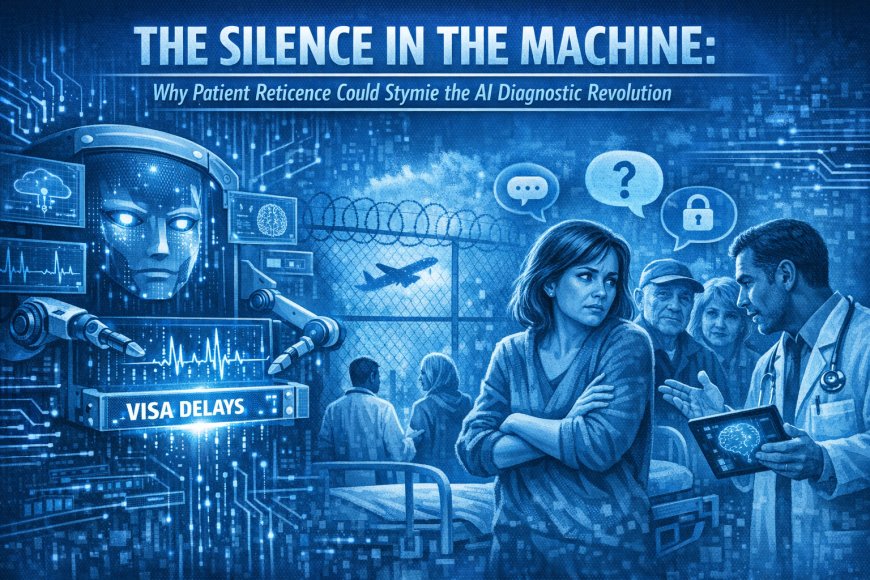
The promise of Artificial Intelligence in healthcare has long been framed as a triumph of data over human limitation. We are told of a future where Large Language Models (LLMs) and diagnostic algorithms offer 24/7 accessibility, instant triage, and a level of precision that exceeds the capabilities of a fatigued clinician.
However, as these tools move from theoretical frameworks into clinical pilot programs, a significant—and quiet—barrier has emerged. It isn't a limitation of processing power or algorithmic bias, but rather a fundamental shift in human behavior: **Patients clam up when they talk to AI.**
This communication gap is more than a psychological curiosity; it is a structural threat to the efficacy of digital diagnosis. If the "input" provided by the patient is sanitized, truncated, or withheld, the "output" of the most sophisticated AI will be fundamentally flawed.
The Nuance of the Human Narrative
In a traditional clinical setting, the diagnostic process is as much an art of conversation as it is a science of observation. Doctors rely on "soft" data—the hesitant pause before a patient describes their lifestyle, the slight tremor in a voice when discussing symptoms, or the tangential detail that seems irrelevant but reveals a systemic issue.
When patients interact with an AI interface—whether it is a chatbot, a voice assistant, or a digital intake form—the nature of this disclosure changes. Recent observational studies and anecdotal evidence from digital health providers suggest that patients tend to provide shorter, more "clinical" answers to AI. They strip away the narrative context, offering the machine what they *think* it wants: dry facts.
This "claming up" stems from a lack of perceived empathy. While AI can simulate empathetic language ("I’m sorry to hear you’re feeling this way"), patients are acutely aware that the machine does not *feel*. Without the subconscious cues of a sympathetic human listener, patients often fail to achieve the "therapeutic alliance" necessary for full disclosure.
The "Garbage In, Garbage Out" Diagnostic Risk
The danger of this reticence lies in the "Garbage In, Garbage Out" (GIGO) principle. AI diagnostic tools are only as good as the data they ingest.
Medical diagnosis is rarely a straight line; it is a mosaic. If a patient feels a subconscious barrier to sharing "embarrassing" symptoms or "vague" discomforts with a digital entity, the AI is forced to work with an incomplete picture. This leads to several systemic risks:
1. **Under-diagnosis of Comorbidities:** Mental health struggles or lifestyle factors are often the first things patients omit when interacting with a non-human interface.
2. **False Negatives:** By providing only the "headline" symptoms, patients may inadvertently lead the AI to overlook subtle indicators of chronic or rare conditions.
3. **Algorithmic Distortion:** If an entire cohort of patients provides truncated data, the AI’s learning model begins to normalize incomplete narratives, potentially baking "silence" into its future diagnostic logic.
The Paradox of Judgment
Interestingly, the "clam up" effect exists alongside a contradictory phenomenon: some patients are *more* honest with AI about stigmatized behaviors (such as drug use or sexual health) because they do not fear human judgment.
This creates a "Digital Paradox." Patients may be more honest about their secrets but less descriptive about their experiences. They might admit to smoking, but they won't describe the specific, lingering quality of a cough in the same way they would to a doctor who is nodding in encouragement. The result is a data set that is high on "checkbox" accuracy but low on "narrative" depth.
Reshaping Digital Diagnosis: The Path Forward
To bridge this gap, the next generation of medical AI must move beyond simple information retrieval. The industry must prioritize "Relational AI"—systems designed not just to calculate, but to elicit.
* **From Interrogation to Conversation:** UI/UX design must shift away from rigid, multi-choice forms toward open-ended, conversational interfaces that use "active listening" prompts to encourage detail.
* **The Hybrid Model:** AI should not be viewed as a replacement for the intake process, but as a collaborative tool. The AI’s role may be to flag areas where a patient seems reticent, signaling a human clinician to explore those specific "silences" during a face-to-face follow-up.
* **Transparency and Trust:** For patients to open up, they need to know where their data goes. Building a "Digital Bedside Manner" requires a transparent framework where the AI explains *why* it is asking a question and how that information assists in the diagnostic journey.
The Bottom Line
The digital transformation of healthcare is inevitable, but its success hinges on a variable we cannot code: human trust. If we build diagnostic tools that patients don't feel comfortable talking to, we are merely building faster ways to arrive at the wrong conclusions.
The future of digital diagnosis won't just be won by the smartest algorithm; it will be won by the interface that knows how to make a patient feel heard. Until then, the silence between the patient and the machine remains the loudest problem in the room.
What's Your Reaction?
 Like
0
Like
0
 Dislike
0
Dislike
0
 Love
0
Love
0
 Funny
0
Funny
0
 Angry
0
Angry
0
 Sad
0
Sad
0
 Wow
0
Wow
0